Skip to content

The Skills Pack / Email-first

Something worth teaching.
Already prepared.

Two packs a month. Six useful skills in each. The first skill is right in your email; the full PDF is attached. Less searching for ideas. More doing something with your kid.

$12/ month

Digital membership. Billed monthly. Cancel anytime.

No account to set up first. Pay securely with Stripe, then we email you a one-tap link that opens your dashboard. It arrives in seconds.

Open a real, complete sample PDF
FROM EMAIL TO DOINGTry each step.

Product example · Skills Pack

Something useful. Already prepared.

Two packs a month by email, six skills in each. A starting skill in the email and the full PDF attached.

  1. 01Open your pack email
  2. 02Follow the step-by-step guide
  3. 03Try it together, then use it again
Open an actual sample PDF

Interactive examples require JavaScript. No child information is collected here.

Illustrative activity from the skill bank. Pack contents vary by age and how you connect. Supplies are not included.

2 packs per paid month

3 practical + 3 people & thinking per pack

PDFs you save are yours to keep

Not another list of activity ideas

The part between
“try this” and “we did it.”

A worthwhile skill needs more than a title. Your first packs give you the preparation, clear steps and specific help for the attempt itself.

Know what you’re getting into.

Supplies, age fit, preparation time, active time and any waiting or cleanup. No pretending a weekend project is a five-minute activity.

Help without taking over.

What Dad models first, what your child tries, and a useful way to tell whether the idea is starting to stick.

Know what to change.

Skill-specific troubleshooting, words to say when you get stuck, and a sensible place to pause. Then a second way to use the idea.

Look at what you will actually use

A real pack.
Not a promise.

Open the sample PDF
See the email and first teaching guide +
  1. 1 · In your inboxExample

    True FatherAges 6–8

    Skills Pack 1: start with Practice staying put when lost (3–5 min)

    One skill ready to start tonight. The full six-skill PDF is attached.

    Start here

    Practice staying put when lost

    3–5 min, the whole skill in the email

    true-father-skills-pack-1-ages-6-8.pdf

  2. 2 · Teach it step by stepExample

    Practice staying put when lost

    3–5 min together

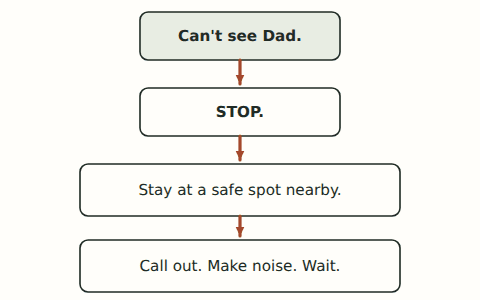
    A flow for a pretend practice: can't see Dad; stop; stay at a safe spot nearby; call out and wait. The exception: if that exact spot is dangerous, move only far enough to be safe, then stop and stay again and seek adult or emergency help.
    Pretend practice, with Dad right there.

    Start: Stand right next to your child in a safe room and say: "This is pretend. We're on a trail and you can't see me. What do you do first?"

    If they say: "I'd go look for you."

    Walk it through: if both of you move, where do you meet?

Read all six skills in this example pack +

A look inside one pack

Six ways to make time together count.

Three practical skills. Three people & thinking skills. Choose a quick win or return to something worth practicing.

Pick what fits. You do not need to finish everything.

Example · Ages 6–8 · Together

Each edition fits one age range and how you connect. Supplies are not included.

Practical skills Make. Try. Improve.

  1. 1. Pack-ready: roll your own shirt

    Quick win · About 3 min

    Pack a shirt neatly and find it again without emptying the bag.

    See the teaching steps

    You need: One T-shirt and a small bag.

    For this age: Fold sides with Dad and roll from the bottom.

    Start with: “Your job: pack this shirt so you can find it when you need it.”

    1. Let your child choose the shirt's spot in the bag. Lay it flat, fold the sleeves inward, then fold both sides toward the middle.
    2. Roll from the bottom toward the collar, keeping the sides even. Pack it, then ask your child to retrieve it without tipping out the bag.
    3. If it unrolls, adjust the width and try again. Ask: What would make this easier to find next time? Let your child make the final choice.

    Let them show you: Let your child show the part they can do, then find the shirt in the bag. Ask: What did you change to make that easier?

    Dad’s turn: Pack one of your own items alongside them. Let their version be different if it works. Close with: Being ready starts with taking care of the small things.

  2. 2. Wind detective: follow the ribbon

    Try together · About 8–12 min

    Use a ribbon to spot where the wind is going and where it comes from.

    See the teaching steps

    You need: Short ribbon; a cardboard tube; tape; an outdoor spot with an adult.

    Take care: Short ribbon only; no neck loops. Stay away from roads, water edges, and storms.

    For this age: Name the direction the ribbon trails using a landmark.

    Start with: “Which way is the wind coming from? Let's make something that can show us.”

    1. Tape a short ribbon securely to one end of a cardboard tube. With an adult, choose a safe open spot and hold it away from your face.
    2. Ask your child to predict which landmark the ribbon will point toward. Watch together: the loose end trails downwind; the wind comes from the opposite direction.
    3. Check again and compare with the prediction. Let your child explain what the ribbon showed. If it hangs still, that is an observation too; save another check for a windier day.

    Let them show you: Ask your child to point where the ribbon trails. For older children, ask where the wind comes from and what evidence helped them decide.

    Dad’s turn: Make your own prediction before checking. If it was wrong, say so plainly. Close with: A good guess gets us started. Checking helps us learn.

  3. 3. Build a gravity run that works

    Build over time · 3 visits

    Build a short paper track, find one weak spot, and test whether a change helps.

    See the teaching steps

    You need: Cardboard base; folded paper channels; tape; one large paper ball; low supports.

    Take care: Use a large paper ball, not marbles around young children; keep the structure low.

    For this age: Join two channels with help and identify where the ball stops.

    Start with: “You design it. We test it. Can your track work three times in a row?”

    1. Let your child choose a start and finish on a low tabletop. Fold paper into U-shaped channels and tape a short route with a gentle descent.
    2. Release the same large paper ball from the same starting point without pushing. Watch for the first place it stops or leaves the track; let your child point it out before offering a fix.
    3. Change only that section and test again. Aim for three reliable runs, counting what actually happens. A run that fails gives you a specific place to work on next.

    Let them show you: Let your child show one change and explain what happened on the next test. Try three runs; unfinished fixes can wait for your next visit.

    Dad’s turn: Ask What do you want to try? before touching the design. At the final visit, name a change your child actually made: You noticed that spot, changed it, and checked again. That is how you improve.

    Your pack includes all 3 visits, with a task and a checkpoint for each.

People & thinking skills Listen. Think. Pause.

  1. 4. Mission read-back: say it, then do it

    Communication · About 3 min

    Repeat an instruction, spot what is unclear, and ask before acting.

    See the teaching steps

    You need: Two nearby, harmless objects.

    For this age: Read back one or two actions before doing them.

    Start with: “Your job is to catch my unclear instruction. Ready?”

    1. Dad gives a short, harmless request: Put the pencil beside the book, then close the book. Use just one action for a younger child.
    2. Your child repeats it in their own words before acting. Confirm what was clear and clarify what was missing. Then try the request.
    3. Switch roles: your child gives Dad a request. Dad repeats it and asks one useful question before acting. End by naming how checking helped you understand each other.

    Let them show you: Give one deliberately vague request, such as Put it over there. Can your child ask which object or where, instead of having to guess?

    Dad’s turn: Take your child's directions seriously and ask without making a joke of their wording. Close with: Asking a clear question is part of doing the job well.

  2. 5. Fact, opinion, or guess?

    Thinking · About 4 min

    Tell a checkable claim from a preference or a guess, and explain how to check it.

    See the teaching steps

    You need: Three spoken statements about a familiar object.

    For this age: Sort see/check versus like, with one clear example of each.

    Start with: “I'm going to say three things. Help me work out what we know and what we need to check.”

    1. Use a familiar object. Dad says: This cup has a handle; this is the best cup; I think it holds two cups of water.
    2. Sort the statements together: something we can check, an opinion, and a guess we have not tested. With younger children, start with just see/check versus like. A checkable claim can still be wrong.
    3. Switch roles and let your child offer a statement. Ask How could we check? or Is that what you like? Choose a way to check one claim without treating confidence as evidence.

    Let them show you: Let your child challenge one of Dad's statements and explain why. Use the categories that fit their age; one well-explained distinction is enough.

    Dad’s turn: Offer a guess and name it as a guess. Let your child correct you when the evidence supports it. Close with: You can change your mind when you learn something new.

  3. 6. Pause, then come back

    Keep practicing · About 3 min

    Ask for a short pause and return with one clear thing to say.

    See the teaching steps

    You need: None.

    Take care: A young child stays with a caring adult. A pause is support, not isolation or withheld affection.

    For this age: Use the phrase with a toy disagreement; Dad supports the return.

    Start with: “You can need a minute and still care about finishing the conversation. Let's practice how.”

    1. Practice while you are both calm. Choose words together: I need a minute. I want to come back to this. A younger child can say Pause, please.
    2. Use a pretend, small disagreement. Dad models the phrase and a brief pause, staying nearby or connected on the call. Return with one simple request.
    3. Let your child try while Dad supports the return. Ask What would help you start talking again? Agree on a phrase you can both use next time.

    Let them show you: During calm practice, let your child use the phrase and return for one sentence or choice. Support the return; this is practice, not a test during an upset.

    Dad’s turn: Keep the promise to return and own it if you miss it. Close with: We can take a minute and still come back to each other.

The whole sequence is in your pack. Clear steps, supplies, adult-help notes, and ways to return to the skill. Projects include every visit. Practice whenever it fits.

These are examples from the current skill library, not a personalized pack. Your selection depends on age range and connection mode.

A small setup. Then it comes to you.

Nothing new to keep up with.

01

Activate. Tell us two things.

Your child’s age range and whether you connect together, on FaceTime or by phone.

02

Prepare your recommended six.

Tap once for a balanced pack. Swap skills first if you prefer; choosing every one is optional.

03

Open the email. Begin with one.

A starting skill in the email, six in the PDF. Your next pack arrives 15 days into the paid month.

Good questions

A little clarity before you start.

What happens after I pay?

Check your email for your activation link. Tell us your child's age range and how you usually connect (together, FaceTime or phone), then tap Prepare my recommended pack. Your first six skills are ready right away, and the pack email follows with one skill ready to start and the PDF attached.

Do I have to choose the six skills myself?

No. We prepare a balanced six for your child's age and how you connect: three practical, three people & thinking. If you would rather choose, you can swap any of them before the pack is confirmed. Nothing waits on you.

When does the next pack arrive?

Your second pack comes 15 days into your paid month. Each monthly renewal starts the next pair. Practice any confirmed skill as often as you like, and move its date on your calendar.

What if it isn't working when we try it?

The skills in your first packs come with what to try when it isn't working, written for that skill: what you might see, what to change, words to say, a good place to stop, and a second way to come back to it.

Can we do this over FaceTime or the phone?

Yes. Choose FaceTime or Phone at setup and the pack fits that setting. Each skill names its supplies and any adult help needed at your child's end.

What if I cancel?

Cancel from your account in a few taps. Your access continues to the end of the month you paid for, including its second pack. PDFs you saved are yours to keep. Supplies are not included.

Be ready for the time you get.

Give them something
worth learning from you.

Two digital memberships. Billed monthly. Cancel in your account.

Want daily preparation and help with tough conversations too? The Full System includes the Skills Pack